In this month of November, we redouble our prayers for the repose of the souls of the Faithful Departed.
Prayer for the dead is a key part of the vocation of Members of our Order, especially for deceased Members and benefactors of the Order, and for Our Lords the Poor and the Sick - and for those who died having no one to pray for them.
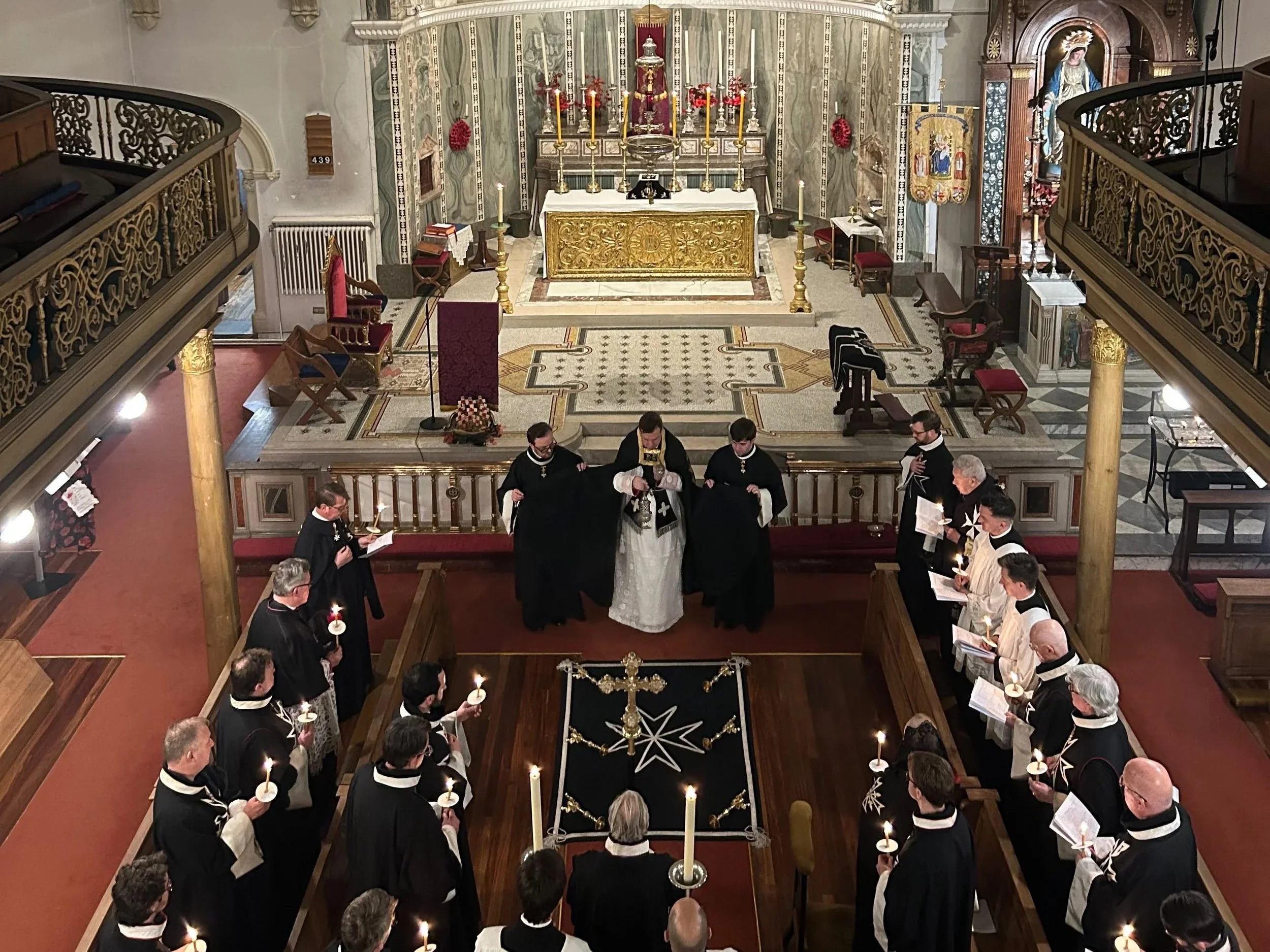
Requiem Masses for these intentions were celebrated in Edinburgh on 4 November at St Patrick’s Cowgate, and in London on 10 November at Our Lady of the Assumption and St Gregory, Warwick Street. Both Masses concluded with traditional prayers for the dead in the form of ‘absolutions’.
We are grateful to Fr Stephen Morrison O.Praem., one of our chaplains, who celebrated the London Mass and has shared his sermon, the text of which is below.
Please pray for the souls of the following Members of our Priory who have died since last year’s Requiems:
The Hon. John Jolliffe + 5 November 2025
Miss Ann Ryan + 11 November 2025
Robin, Viscount Bridgeman + 9 April 2026
Charles, Count de Salis + 3 September 2026
Mrs Charles Fingleton + 3 September 2026
Philip Mercer of Hillslap + 21 October 2026
Sermon for the annual Requiem Mass of the Grand Priory of England
We are used to holding on to the Christian virtue of hope, whenever we participate in a Requiem Mass. In this year, when our Order gallantly joined the fight for Life in our nation, and knew a quiet sense of victory, at seeing the Assisted Suicide legislation fall in the House of Commons, our Requiem this year contains more than a usual glimmer of hope, that silver-lining that embroiders all our funereal black on these occasions. It is the hope of freedom from the tyranny of Death, whose ugly presence threatens our culture of Life; like the psalm, we can say, momentarily, “our life, like a bird, has escaped from the fowler’s snare.” As members of our Order we claim no glory for ourselves in this victory – the Victor is Christ, present among us, who conquers death once and for all, by His Cross; and that Victory is made continuously present to us through His Church. But we can smile at a fight well-fought, even as it goes on – especially for the unborn, who sadly remain more threatened than ever. But since the victory is, and always will be, Christ’s, we can mourn our deceased members with an even surer and more certain hope of resurrection. Death has been conquered. Our ranks are not, in fact, depleted by the death of our confreres. Our members have passed from the infantry of the Church Militant here on earth, but we have prayed today for their swift transit to the armies of light. The Offertory for this Mass sings: “yet, may the standard-bearer Saint Michael lead them forth into that light which thou didst promise to Abraham and his seed… Make them cross over, Lord, from death to life.”
It is an irony that will not have been lost on any of you, that the legislation for Assisted Suicide was trendy among the very people who claim to have such concern for people’s mental health; or, at least, the two trends occurred simultaneously in the media. There are those who rightly promote the kind of conversation which may dissuade a man from taking his own life, who nonetheless think that it is “merciful” to allow another to go ahead and end his suffering. The only logical, yet terrifying, conclusion one can draw from this societal duplicity is that, to them, some lives are more valuable than others; the young working person is of more “use” than the elderly or terminally ill. This is the same lie that we fight against with other Life issues: each life is sacred and to be cherished: the mother’s, and the baby’s (and the father’s, for that matter); the care-giver’s and the care-receiver’s. As Hospitaller Knights and Dames, we honour the sanctity of the life of our Incarnate God when we minister to the souls and bodies of the sick, the weak, the underprivileged, and those not considered “of use” to society. Today, at this Requiem Mass, we show the same honour to the human souls of the dead as we do to the living, ministering to them – as we only can in Christ – by the compassion of our suffrage and prayers on their behalf.
Sir Arthur Conan-Doyle put a very apposite message on the lips of his character, Sherlock Holmes, in his story “The Adventure of the Veiled Lodger.” A woman horribly disfigured by a misfortune seems, to Holmes, vulnerable to suicide. The passage reads: “He turned swiftly upon her. “Your life is not your own,” he said. “Keep your hands off it.” “What use is it to anyone?” “How can you tell? The example of patient suffering is in itself the most precious of all lessons to an impatient world.” What an instructive passage for our times! The BBC series “Sherlock” – beloved by many for the talents of Benedict Cumberbatch – chose to include these words, but elaborate them. In the version for television, Cumberbatch’s Holmes says to the vulnerable lady: “Taking your own life. Interesting expression — taking it from whom? Once it’s over, it’s not you who’ll miss it. Your own death is something that happens to everybody else. Your life is not your own. Keep your hands off it.”
These lines have been highly praised by charities and individuals concerned about preventing the tragedy of suicide. It was a message we sought to preach this year, too. I just want to focus on one line of it: “Your own death is something that happens to everybody else.” We know that this is true; we experience the grief of losing our loved ones, and while we know that for them, death is not the end, we are the ones who go on experiencing their loss… it happens to us. People often remark that “when he left us, a part of me died with him’, or ‘something died in me.’ Many of you will know all too keenly that sentiment. It is true of great figures who mark the age, too: how many people remarked, after Queen Elizabeth’s death, that it was the dying of an entire era?
I want now to turn that phrase around, and to place it on the lips of this congregation, praying to our Saviour: “Your own death, O Lord, is something that happens to everyone else.” We can say this because it was true, at our Baptism. In baptism, we died with Christ and rose with Him. His Death, and, crucially (no pun intended), His Resurrection, happened to us. Our lives are not our own, they are His. But His life is His own, to lay down for His sheep – for He alone could say, “I have power to lay it down, and I have power to take it again; this charge I have received from my Father” (Jn 10:18). In the Requiem Mass, we apply the merits of His saving Death and Resurrection to the lives and deaths of our loved ones. In a real way, during this Mass, His Death happens to them. Having known the Cross, we pray that they may know the glory of the Resurrection. While we tell society “hands off” the lives of the vulnerable, we realise with humble gratitude that all life is in His Hands, and further, that all life is redeemed by the nails that we hammered into His Hands. Our life was sacred before; it is now consecrated with ineffable and indestructible dignity. His death is our ransom from death. His rising is our hope of resurrection. Truly, the paschal mystery is not something that happened only to Him – it happens to everyone else. Therefore, “tantus labor not sit cassus,” we prayed in the Dies Irae: “Faint and weary thou hast sought me, / On the cross of suffering bought me, / Shall such grace be vainly brought me?” So it is that our black today is rightly edged in gold and silver. There is hope even amid death. The Cross of our Order shines from our breasts, white seen more clearly against the black. May those who wore that Cross in life, and who have “gone before us marked with the sign of Faith, and who now sleep the sleep of peace,” be given “a place of refreshment, light and peace.” As the Pie Jesu has it: “Lord, all-pitying, Jesus blest, / Grant them thine eternal rest.” Amen.
The Very Rev. Stephen Morrison O.Praem.
Magistral Chaplain
10 November 2026