St John’s Day celebrations
On 23rd and 24th June, the Order in Britain celebrated our patronal feast, the Nativity of St John the Baptist.
Celebrations commenced with sung First Vespers on the eve of the feast, at Our Lady of the Assumption & St Gregory, Warwick Street. Members of the Order then gathered for the annual BASMOM Members’ drinks at Boodles.
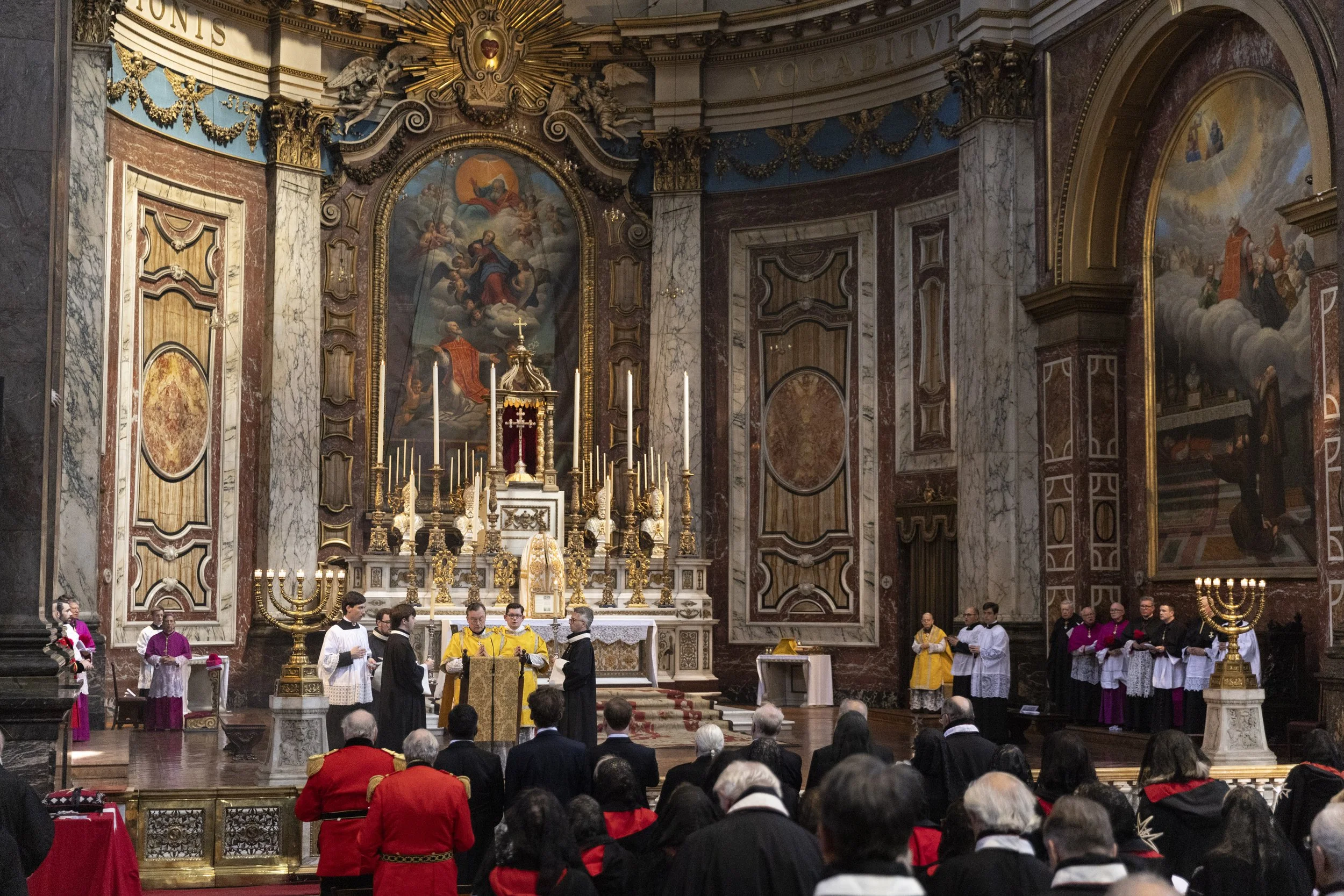
The next morning, a solemn Mass was celebrated at the London Oratory, attended by more than one hundred and fifty Members, their families and friends, members of the Venerable Order of St John, the Equestrian Order of the Holy Sepulchre, and the Constantinian Order, volunteers, and employees of the Orders of St John Care Trust. It was a honour to welcome once against the Apostolic Nuncio to the Court of St James, Archbishop Buendia, who attended in choir, alongside many of our chaplains.
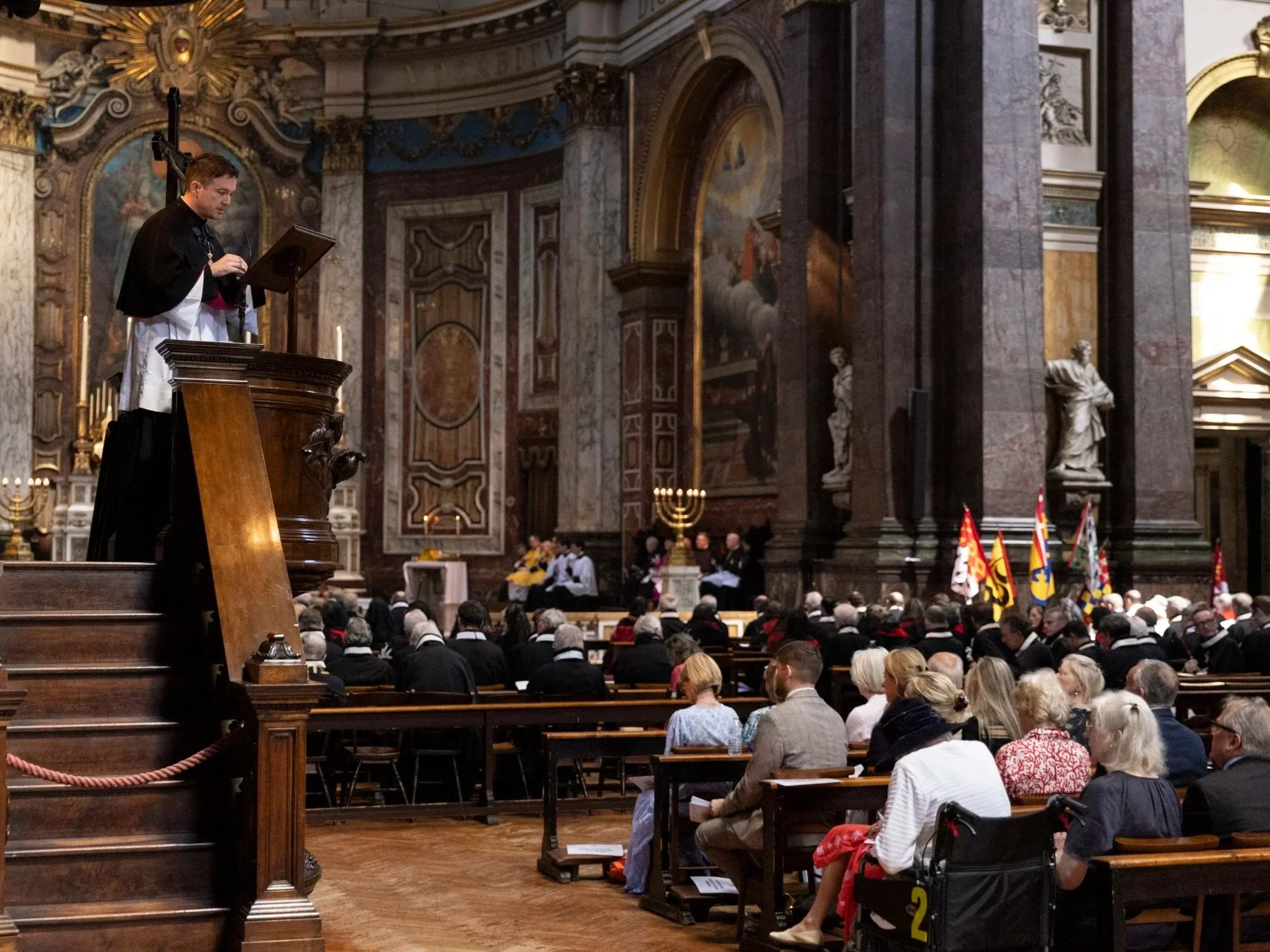
In his sermon, Fr Edmund Montgomery, Magistral Chaplain, invited us to meditate on the words spoken by the crowds at the birth of St John Baptist, ‘What then will this child be?’ (Lk 1:66), and ask this question of ourselves, at the two points in time that matter: now, and at the hour of our death. You can read the full text of Father Edmund’s sermon below.
After the sermon, ten new Members of the Order were received into the Religion by the Procurator of the Grand Priory of England, Fra’ Richard Berkeley-Matthews, assisted by Lady Celestria Hales, receiving the white cross of the Order. At the end of Holy Mass, Lady Celestria distributed awards in the order pro merito Melitensi, which recognises those who have made signal contributions towards the Order and its charism of tuitio fidei et obsequium pauperum.
Let us pray for our whole Order, especially those newly admitted and those who lead us, that, in the words of our Daily Prayer “we remain faithful to the traditions of our Order”, to greater glory of God and the good of our souls.
HOMILY FOR ST JOHN’S DAY, 24 JUNE 2026
Fr Edmund Montgomery
‘What then will this child be?’ Lk 1:66
With these words, so the fame of the baby Baptist spread: ‘What then will this child be?’ These sentiments express an expectation. The potential of the son of Zechariah and Elizabeth is given further life when the Gospel tells us, ‘…the child grew and became strong in spirit…’
On the Road to Emmaus, we hear of the shadow of expectation, which is disappointment. Remember how the travellers opened their hearts to the Lord such that, unknown to them, they told Him of their profound disappointment in Him: ‘…we had hoped that he was the one who was going to redeem Israel.’
Expectation and disappointment. ‘What then will this child be? ‘We had hoped that he was the one…’
On our wedding day: What then will my marriage be?
On our ordination day: What then will my priesthood be?
When our children are born: What then will my son or daughter be?
When we get a job: When then will my work be?
When we join the Order: What then will this Order be?
When our superiors are chosen: What then will our superior be?
Each of these meet with disappointment, if we are truthful:
I had hoped my marriage would be…
I had hoped my priesthood would be…
I had hoped my son or daughter would be…
I had hoped my work would be…
I had hoped the Order would be…
I had hoped our superior would be…
Expectation and disappointment can be the measure of our lives if we decide to measure our span of years through the lens of ambitions and gain or failure and loss. It can even be the way we measure the Order.
Our Lady is the one who corrects us in the prayer we perhaps learnt first, the Hail Mary: the true shibboleth of the Christian is not expectation and disappointment, but rather the only two moments of our life that ever belong to us: ‘…now and the hour of our death.’ In the spiritual life, Heaven asks us to live our lives not between expectation and disappointment but between the present moment and when we enter eternity.
This is because the Almighty wishes us to understand that we can only confront our mortality, and go to Him as a friend, embracing the moment of death if we decide each moment to evoke the crowd at the birth of the Baptist: ‘What then will this child be?’ What then will I be? In my life: What then will Edmund be? What then will my priesthood be? For you, what then will I be? What then will my marriage be? What then will my family be? What then will being a member of the Order of Malta be? What then will being a leader in the Order be?
We never want it said of us, echoing Emmaus:
We had hoped that priest was the one to help us…
We had hoped that my spouse would keep their vows…
We had hoped that our children would support us as we grow old...
We had hoped that joining the Order would have helped my Faith…
We had hoped our superiors would have been faithful to their Office…
The Gospel tells us that the ‘...the child grew and became strong in spirit.’ We can understand both: the baby Baptist did grow, of course, in the physical sense, but the Gospel here surely wants us to understand that St John grew not solely in the ordinary way a baby becomes a toddler and then a child, an adolescent, and then a man, but rather that same progression in his soul: he reached the fulness of maturity. What then will this child be? No longer a child. He grew up. What he was in potential, he became.
Maturity in the spiritual life means as St Paul wrote, ‘When I was a child, I spoke as a child, I understood as a child, I thought as a child: but when I became a man, I put away childish things.’
Confrères, it is time to put away childish things. If not, we cannot imitate our holy patron, who the Gospel tells us became ‘strong in spirit’ only when he grew. We must mature to become strong in spirit.
To grow means to change without losing that which is essential. Change has been required of us in our Order with every passing year. If our beloved St John Henry Newman’s famous saying ‘To live is to change, and to be perfect is to have changed often’ were applied to the Order, given all we have undergone, we would be an association of the immaculate and an army of saints. We have changed often, our Order in Great Britain, we must resolve to become perfect through such change and so fulfil the prophetic expression of St John Henry.
You will be familiar with that line from Twelfth Night, ‘Some are born great, some achieve greatness, and some have greatness thrust upon them.’ This could be the briefest biography of the Baptist: he was born great, sanctified in the womb, he achieved greatness – Our Lord said, ‘Of men born of women, none is greater than John the Baptist,’ he had greatness thrust upon him at the edge of the sword of Herod’s executioner in his martyrdom.
For us, I would suggest that Providence invites us to consider the question the crowd offers us as our motivation and examination of conscience: ‘What then will this child be?’ What then will I be? becomes the question when we apply it to ourselves.
And returning to the two moments the Hail, Mary confronts us with: ‘…now and the hour of our death’ – the only two moments we can hold in our hands – what then will I be now? What then will I be at the hour of my death?
Every choice we make now determines who we are. Every choice we make now determines who we will be at the hour of our death. We must have a constant vigilance over our soul such that we cannot be complacent: I will be good tomorrow, I will pray the day after, I will be faithful to my vows next week, I will be a good priest next month, I will stop sinning next year.
This is the vocation to which the baby Baptist calls us on his Nativity. If the crowd asked themselves of him: ‘What then will this child be?’ We must ask the same question of ourselves: ‘…now and at the hour of our death,’ what then will I be?
Dear confrères, let us pray for one another in this Holy Mass. Providence gives us, through His grace, so much potential and our Lady, the angels, and the saints stand ready to help us by their prayers. Hear the question: What then will I be? What then will the Order of Malta be? Let us grow, as the Baptist. Let us become strong in spirit.
In the Name of the Father and of the Son and of the Holy Spirit. Amen.