Victory Mass - Our Lady of Philermo
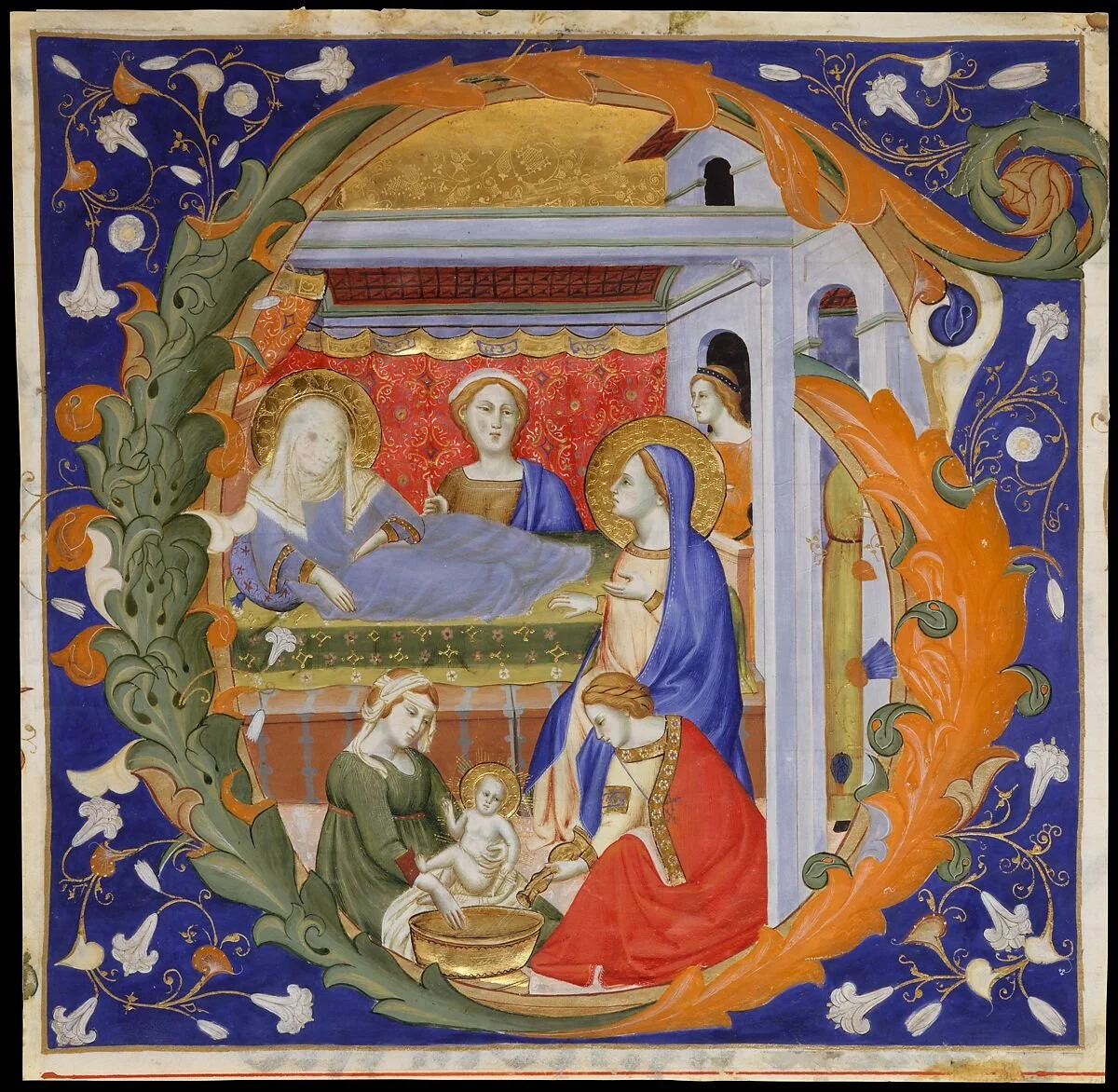
On Tuesday 8 September, the Grand Priory kept the great feast of the Nativity of the Blessed Virgin Mary. This feast has a triple significance for our Order. Not only do we mark our Blessed Lady’s earthly birth, we also honour her today especially under her title ‘Our Lady of Philermo’, patroness and protector of our Order. And finally, we celebrate a particular sign of our Immaculate Mother’s special love and favour of the Order, for, on this day in 1565, a Spanish relief force arrived at Malta signalling the end of the four month Great Siege, during which Grand Master Jean de Valette and his small force of knights, sergeants and mercenaries held out against the might of Suleiman the Magnificent’s forces.
Holy Mass was celebrated at Our Lady of the Assumption & St Gregory, Warwick Street. During Mass, Hannah and Benedict Jennings renewed the Promise of Obedience, and Declan Ganley Esq. was admitted to the Order.
Fr Joseph Hamilton, chaplain of our Order and rector of the Domus Australia in Rome, preached the sermon, which we reproduce below with his kind permission.
Our Lady of Philermo - pray for us!
SERMON FOR THE VICTORY MASS
Our Lady of the Assumption & St Gregory, Warwick Street, London
September 8th 2026
Today the Church celebrates the Nativity of the Blessed Virgin Mary. Today’s feast, and its counterpart, the Assumption (which we celebrated just a few weeks ago) form the bookends of the life of the Immaculate One. The early Christians venerated and loved the Mother of God: around the middle of the second century the Protoevangelium of James appeared, which named Our Lady’s parents and told us something about them, and recounted a little about her own childhood. The celebration of today’s feast flows from that apocryphal text, which, although not part of the Canon of Scripture, suggests the existence of an oral tradition of greater antiquity, which some have argued stretches back to the Apostolic period itself, or at the very least the years immediately following the death of the Apostle John.
The origins of the Assumption, from which this church takes its title, are slightly more complicated, but dogmatically more surefooted. The earliest textual witness we have of this belief is the Liber Requiei Mariae, preserved in Ethiopic, with related traditions surviving in other ancient Christian languages and transmitted in Latin, in the Corpus Scriptorum Christianorum Orientalium (don’t all rush to look it up at once - it’s on reserve in the Bodleian Library in Oxford).
In 1950, when the dogma of the Assumption was defined, there were criticisms from the Protestant churches that the witness to the Dormition was not sufficiently ancient, despite the rich body of tradition in circulation. We are liberated as Catholics by the dogma of the Assumption, not as a pious embellishment, but as revealed truth preserved in the living tradition of the Church and solemnly defined by the Magisterium. In fact, the proclamation was received joyfully almost universally by the Catholic faithful across the world.
Immaculate Conception, Assumption, Nativity, Victory.
Today, our Order rightly celebrates the Blessed Virgin’s intercession in ending the Great Siege of Malta in 1565. It is utterly correct for us to be thankful for that intercession and to honour her for it. In the last passages of the Liber Requiei Mariae, Jesus reinfuses Mary’s soul into her body, and a throne appears to his right, surrounded by angels. We believe that the Queen of Angels has a special place in her heart for the sons and daughters of Jesus’s cousin, John the Baptist. Being part of the family, so to speak, we can claim a very close spiritual link to her – perhaps even closer than other religious orders, even the Franciscans or Dominicans!
And so, a question on this great feast: how do we honour her, Our Blessed Mother, on this, her birthday, at this Victory Mass? What do we bring to her? Our devotion, our trials, our sufferings, our joys, our prayers? How will each one of you, dear brethren, honour the Queen of Angels on this Day of Victory?
And what does victory even mean to us? Political, spiritual, cultural, religious, economic, military, personal, moral? Those of you renewing your Promises of Obedience this evening, what is victory? You, Declan, admitted to our Order during this Mass, what does victory look like? The Professed; and all of you who hold various responsibilities and offices in the Order, what does victory look like? For us, the chaplains, what does victory look like? Faithfulness to vocation, to family, to the Order, to the Church? If so, faithfulness up to what point? To the point that it makes us happy, or all the way unto death?
Victory is not just getting to Heaven. That’s the vocation of us all. Victory is arriving there adorned with good works, and a life lived faithfully to our charism. Arriving there with the scars, yes, real scars, the scar tissue of battle with sin and the demon, not arriving there with the sleek pelt of moral compromise, or the smooth skin of surrender to sin. That is not victory…
We grieve for those of our brethren who have abandoned the spiritual conflict and passed on the crown of victory. And for what? The fleeting happiness the world can give? The sweet surrender to sin? The relief of abandoning the spiritual combat and the battlefield, that ALL Knights of St John are called to?
For as long as our Order on Earth endures, it will not be for any of us, even those who have fled the white cross of the Beatitudes, to suffer the fate of those poor souls who die having no one to pray for them whilst they are in Purgatory. We will be remembered year after year in Mass after Mass, suffrage after suffrage. That is an enormous privilege, and, being the beneficiaries of so great a blessing, the Lord expects much of each one of us. And we must pray for those who fall short.
Nearly 10 years ago in Walsingham, I recounted to you the story of Fra’ Abel de Bridiers de la Gardampe. The defence of Fort St Elmo during the Great Siege of Malta in 1565 is widely remembered as one of the most heroic and brutal military stands in Christian history. Grand Master Jean de Valette had hoped the fort might hold for only a few days. In God’s providence, and by the courage of its defenders, it resisted the Ottoman army for nearly a month.
At the beginning of the siege, a small company of our brethren was sent by the Grand Master to defend the islet and the fort that guarded the entrance to the harbours. When Mustapha finally called off his troops after the first assault, it was estimated that he had lost nearly 2,000 men, many of them from the cream of the Janissary advance guard. The defenders had lost only ten Knights and seventy soldiers.
It was at the close of that day that a Knight of the Auvergne, Fra’ Abel de Bridiers de la Gardampe, maybe 27 years old, was shot and mortally wounded. As his friends ran to help him, he motioned them back with the words: “Count me no more among the living. Your time will be better spent looking after our other brothers.” While the cannon thundered, while fire rained down from the walls as if from Hell itself, and while the Janissaries came on in wave upon frenzied, screaming wave, Bridiers de la Gardampe dragged himself to the chapel of St Elmo. Later that afternoon, when the Knights of the Order made their way to the chapel to give thanks for what seemed almost a miraculous victory, they found the Knight of Auvergne stretched dead at the foot of the altar. Not even on the bottom step. At the foot; where at Mass he had served the God who gave joy to his youth: ad Deum qui laetificat juventutem suam.
That is what victory looks like.
That is how a Knight of Malta lives.
That is how a Knight of St John dies.
+ In the Name of the Father, and of the Son, and of the Holy Spirit.
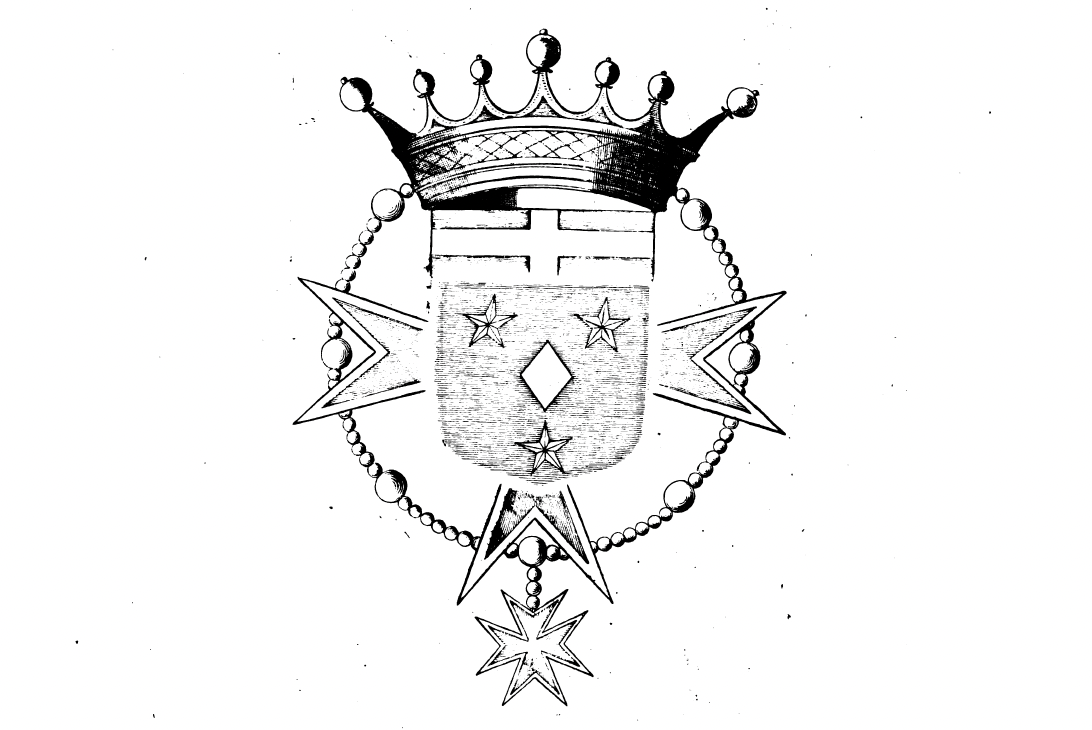
The arms of Fra’ Abel de Bridiers de la Gardampe, no. 77 in the Martyrologie of the Order.