
A Lenten Journey: Part 2 - the Good Samaritan
This second week in Lent, we travel on the second part of our journey with Our Lord to Jerusalem for His Passion as told by St Luke. To start, take down your Bible and read Luke 10:25-37.

The road from Jerusalem to Jericho today © Bruce Whittingham
“But a certain Samaritan, as he journeyed, came near him: and seeing him, was moved with compassion.” (Lk 10:33)
Having resolved to “set our faces” with Christ toward Jerusalem this Lent, we now encounter the first lesson of this pedagogical journey. Unique to St Luke, the Parable of the Good Samaritan arises from a lawyer’s attempt to “test” Jesus concerning the Double Precept of Charity: love of God and love of neighbour.
Our Lord directs him to the very heart of the Torah: “Thou shalt love thy neighbour as thyself” (Lev 19:18). This verse stands at the structural centre of the Mosaic Law and, as St Paul affirms, is its fulfilment and summary (Gal 5:14; Rom 13:9-10).
By way of illustration, Jesus describes a descent — a katabasis, in the language of classical epic. While He Himself is going up to the city of sacrifice, the generic “man” of the parable is “going down” (Lk 10:30)—in the opposite direction—from Jerusalem to Jericho, the lowest city on earth. It is a journey away from the Divine Presence, a descent into the woundedness of sin, where humanity lies “stripped” and “half dead”.
The priest and Levite pass by: the Law alone cannot save. Then comes the Samaritan, who is “moved with compassion”. The Greek is visceral: literally, ‘his bowels were stirred’. Luke reserves this ‘gut-wrenching’ verb for moments of divine compassion: Christ at the sight of the Widow of Nain (7:13); the parabolic Merciful Father embracing the prodigal son (15:20). The same idiom appears in the Benedictus, when God visits fallen humanity “through the bowels of [His] mercy” (1:78): the very motive of the Incarnation. God takes on human flesh—human innards—in order to be moved by this visceral loving-kindness.
Catholic devotion has traced this movement upward—and thankfully less gastric—from the gut to the Heart. The Sacred Heart is divine compassion made visible: the Heart pierced on Calvary from which flowed blood and water. The Samaritan pours oil and wine; Christ pours out His life.
Mercy and compassion are not mere feelings, but actions. In the Samaritan’s care—tending wounds, providing shelter, paying for sustenance—we find the Corporal Works of Mercy (Catechism of the Catholic Church §2447) in narrative form. For the Order, the Samaritan’s two denarii resonate as its twofold mission: tuitio fidei and obsequium pauperum — through which its members are sanctified (“inherit eternal life”, Lk 10:25) and give glory to God (Constitutional Charter, art. 2 §1).
To follow Christ toward Jerusalem is to defend the faith with fidelity and to serve the poor with compassion. Christ is the true Samaritan; from His Sacred Heart flows the mercy that heals us and sends us forth to “go and do likewise” (10:37).
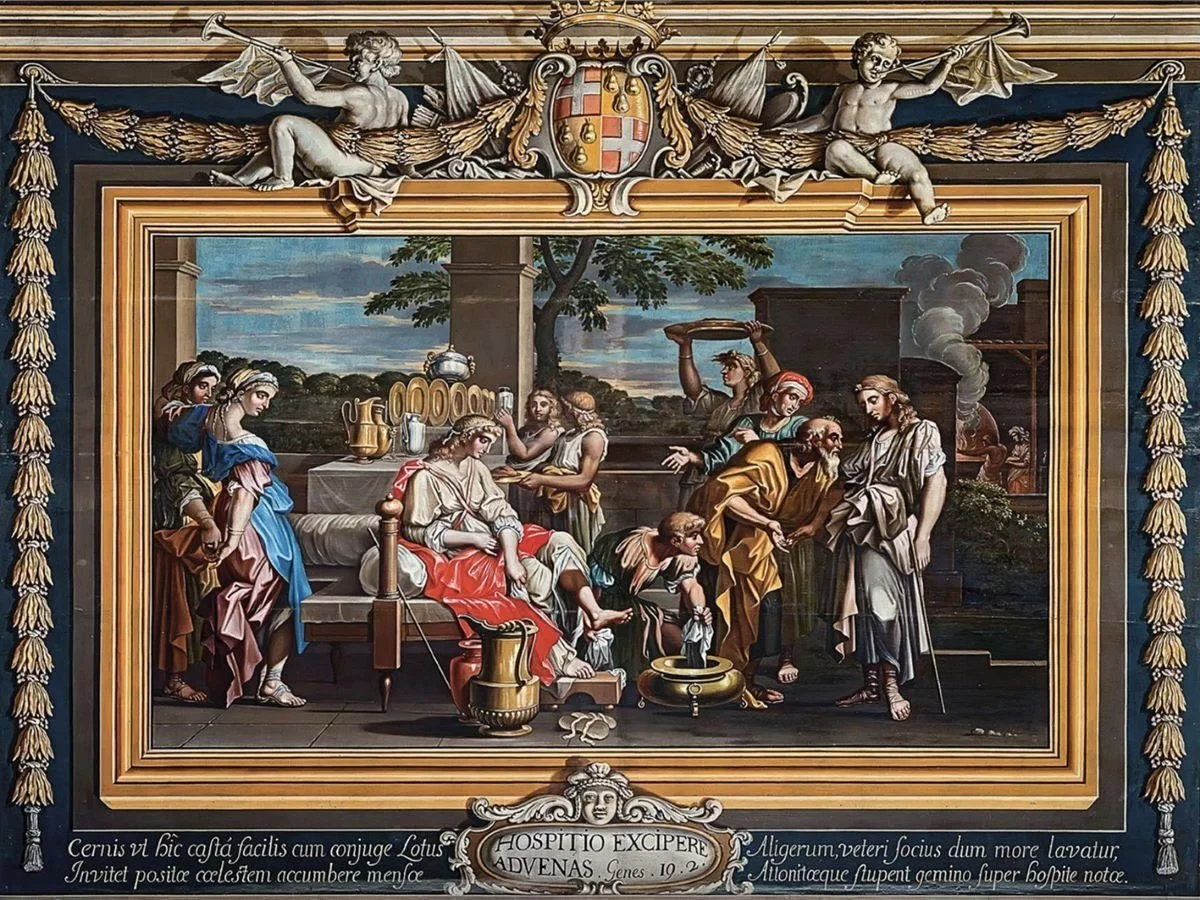
‘Harbouring the harbourless’: one of six murals, depicting the Corporal Works of Mercy, from the Grand Master’s bedroom at the Palace in Valletta © Daniel Cilia
