
Martha & Mary - A Lenten Journey, Part 3
Fr Gwilym Evans FSSP—writing from Jerusalem—shares the third meditation in our Lenten series, as we read through St Luke’s Gospel, reflecting this week on Luke 10:38-42.

Henryk Siemiradzki, Christ in the House of Martha and Mary, 1886, oil on canvas, Russian Museum, St Petersburg (Wikimedia Commons)
“And she had a sister called Mary, who sat at the Lord’s feet and listened to His word.” (Lk 10:39)
Continuing our Lenten journey toward Jerusalem, we arrive at the house of two sisters. This brief episode—just five verses and, once again, unique to St Luke—follows immediately after the Parable of the Good Samaritan. The juxtaposition is surely deliberate: the two scenes form a kind of diptych illustrating the Double Precept of Charity. If the first panel taught us love of neighbour, the second reveals the absolute primacy of the love of God.
The contrast is subtle. Martha is busy with generous hospitality, while Mary “sat at the Lord’s feet and listened to His word [logos].” In the ancient world this was the posture of a disciple (cf. Acts 22:3). Mary appears as a true and perfect disciple — another Lucan reversal (the ‘Magnificat dynamic’, cf. Lk 1:52). Just as the schismatic Samaritan proved neighbour to the wounded man, now a counter-cultural woman assumes the role of rabbinic student, listening attentively to the Word (cf. Ps 119 [118], esp. v. 105)
Martha’s problem is not that she serves, but that she “was distracted” (10:40). The Greek verb Luke employs means ‘drawn away’ or ‘pulled in different directions’; I quite like “discombobulated” (the KJV has the wonderfully old-fashioned “cumbered”). She resembles the priest and Levite who “pass by”: preoccupied with their own concerns, they fail to pay attention to what—or Who—truly matters. We might say: they are pushing the wheelchair, but not speaking to the guest!
The lawyer in the previous scene asked, “What must I do to inherit eternal life?” (10:25). Only at the end of the chapter does Jesus provide the ultimate answer: “One thing is necessary” (10:42). Behind this cryptic response lies a fundamental principle, formulated by the Latin schoolmen as agere sequitur esse — ‘action follows being’. Before we act, we must first become disciples.
Mary embodies this prior state of being — of receptivity. She listens; she receives; she becomes a disciple, formed by the Divine Word. That should be our aim with these weekly meditations: a slow prayerful daily reading of Sacred Scripture—known to Catholic tradition as lectio divina—whereby we sit at the feet of the Lord before we set our hands to work.
The figures of Mary and Martha show us the internal logic of the Order’s motto: tuitio fidei et obsequium pauperum. The et is not merely a conjunction; it is an order of operations. First, we guard and cherish the faith — an intimate custody (‘defence’ is too military a translation!) of the Truth that defines who we are; only then can we truly serve the poor in what we do. Without Mary’s prayerful listening, our service is hollow; without Martha’s charitable action, our contemplation is sterile.
We must learn to be both sisters at once: Mary in Martha. Listening before acting — or, as St Ignatius would say, ‘contemplatives in action’. Only then will the Word we hear in prayer become flesh in the works of mercy we perform.
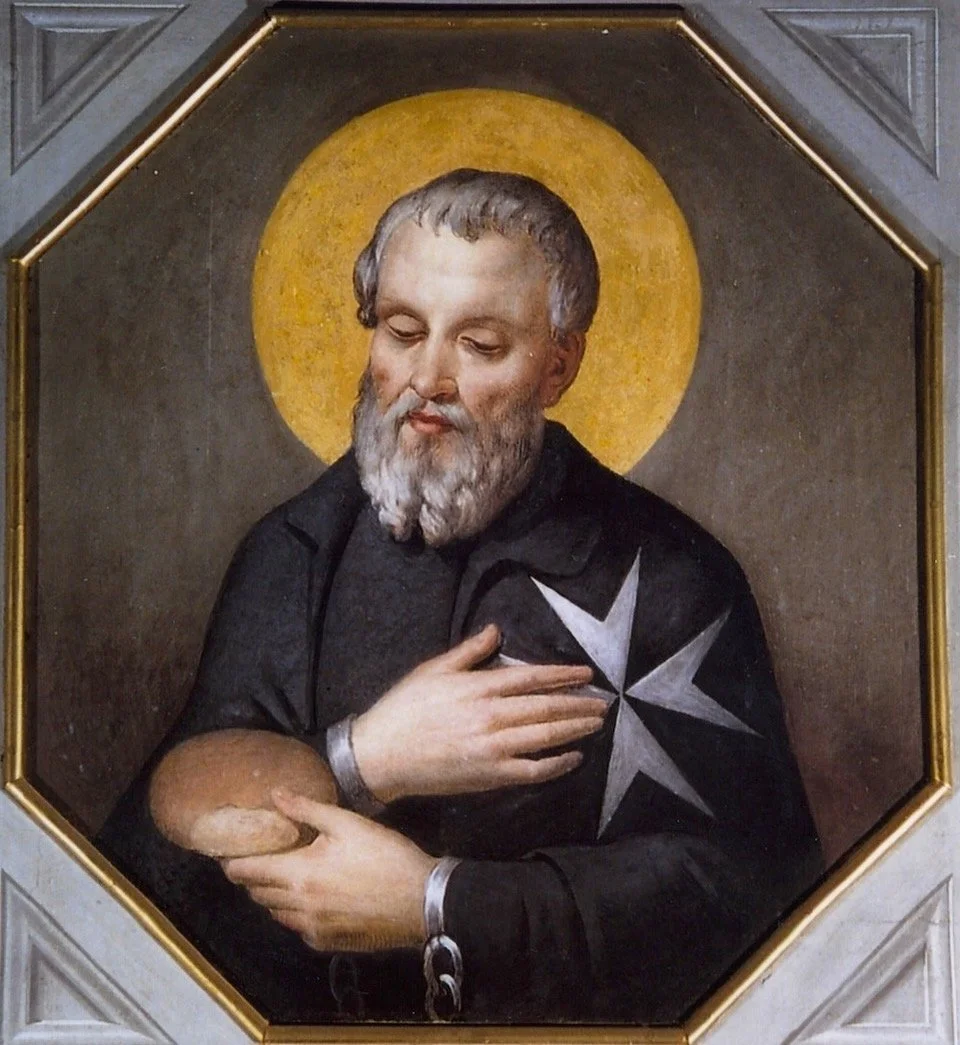

Blessed Gerard:, Founder of our Order
Tuitio fidei (cross), obsequium pauperum (bread), and resolute sharing in Christ’s Passion (chains) — all incarnate in one faithful life (17th-century fresco, Chapel of the Grand Magistry, Palazzo di Malta, Via Condotti, Rome (Wikimedia Commons))
