
John the Baptist: Prophet of the Old, pointing us to the New
On 31st January, the Grand Priory met together for our first Day of Recollection of 2026. Our monthly Days of Recollection are day-long, ‘micro-retreats’, during which members of the Order come together to sing the Divine Office, offer Holy Mass, and attend spiritual conferences. This month, the Day was led by Fr Gary Dench, parish priest of Hutton and Shenfield in the Diocese of Brentwood, and a longstanding friend of the Order, having volunteered with the Order and served at Mass for the Grand Priory before he was ordained priest.
Fr Gary has kindly allowed us to publish the first of his wonderful spiritual conferences, on our Holy Patron, St John the Baptist.
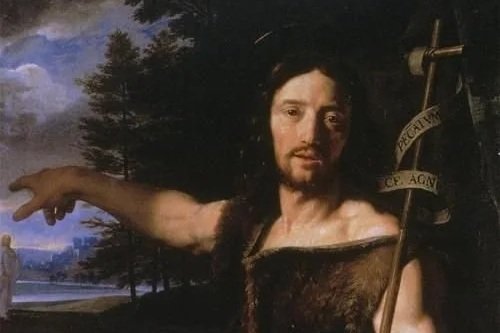
John the Baptist: Prophet of the Old, pointing us to the New
Fr Gary Dench, 31 January 2026
In those days came John the Baptist, preaching in the wilderness of Judea, “Repent, for the kingdom of heaven is at hand.” For this is he who was spoken of by the prophet Isaiah when he said,
“The voice of one crying in the wilderness:
Prepare the way of the Lord,
make his paths straight.”Now John wore a garment of camel’s hair, and a leather girdle around his waist; and his food was locusts and wild honey. Then went out to him Jerusalem and all Judea and all the region about the Jordan, and they were baptized by him in the river Jordan, confessing their sins.
But when he saw many of the Pharisees and Sad′ducees coming for baptism, he said to them, “You brood of vipers! Who warned you to flee from the wrath to come? Bear fruit that befits repentance, and do not presume to say to yourselves, ‘We have Abraham as our father’; for I tell you, God is able from these stones to raise up children to Abraham. Even now the axe is laid to the root of the trees; every tree therefore that does not bear good fruit is cut down and thrown into the fire.
In the Name of the Father, and of the Son, and of the Holy Spirit. Amen.
In the great procession of figures who pass across the pages of Holy Scripture, few are so arresting, and few so singular, as John the Baptist. He stands at the meeting point of two worlds. Behind him lies the long history of Israel’s waiting. From the night of the Exodus, Israel was drawn out of slavery and bound to God by covenant, yet again and again turned aside in the wilderness and in the land. Through judges and kings, through triumph and ruin, God remained faithful while his people faltered. And so he sent the prophets to recall their hearts, until at last, in the silence of centuries, a lone voice rose in the desert: ‘Prepare the way of the Lord.’ Before him opens the age of fulfilment. He is the last of the prophets of the old covenant and the first witness of the new. He does not merely speak of the Messiah. He points to Him with his own hand, before a crowd of his own disciples. And in the presence of a crowd of his own disciples he says that is not worthy to untie the strap of his sandal. He draws them, and generations of disciples, into a transformative and life-changing relationship with the Lord, and he does it with a simply word: ‘Behold.’
And yet. . . .
I don’t know about you… but I have always wondered….
Did he really eat grasshoppers? We can’t speak of St John the Baptist without addressing, with due reverence for our holy patron, and a faint shudder, his diet. Did he really crunch his way through crickets while preaching fiery sermons designed to wake people from the slumbers of sloth and sin?
It's always assumed that this was exactly the case. And the idea is not as far-fetched as one might think. There are parts of the world where insects, including locusts, remain a delicacy. The law of Leviticus specifies locusts, among a series of other insects, as permissible to eat. Most definitely, perhaps, food for the poor. And even today in the west there is the possibility for the more health-conscious to buy protein powder, or meal replacement powders, made up from ground-up crickets.
But for John the Baptist this is something far from clear-cut and there are different theories about what the locust might be referring to if not an insect. All across the mediterranean world, to give one illustration of the debate, is a kind of tree. It grows in arid climates. It even grows in deserts. A carob. It produces these kind of leathery brown pods, and they grow down in clumps almost like bananas. Inside is a kind of sweet pulp which can be eaten. This, with honey, would have been enough to sustain a simple subsistence, albeit a very sweet and sugary one. It’s also possible that ‘locust’ refers to a kind of simple pancake, the word for which is very similar to the Greek for the large grasshopper, and was eaten with. . . you may have guessed it. . . honey. It’s less dramatic but nevertheless, in this absence of meat in the sense of animal flesh, we find the living out of a simple, penitential life in harmony with his penitential-themed preaching.
But I’m a man for the dramatic. So let’s go with the grasshoppers and hop and bound our way back to the main point of this first talk.
‘Locusts and wild honey’, does not appear in any modern cookery book, and it is safe to say that John would not have been invited onto MasterChef, celebrity or otherwise. John crunches his way through the wilderness like a man entirely uninterested in comfort or luxury. Quite the opposite in fact. He embraces a lifestyle meant to challenge people in their own manner of living. And the Gospel depictions of him are clearly intended to shock. The odd menu, and the Gospel writers determination to make reference to it, makes his message all the sharper. He is not here to blend in. Not with what he wears. Not with what he eats. Not with what he says. He is not offering gentle lifestyle tips. He is not the urbane lifestyle guru of a metropolitan broadsheet. His very way of living says, ‘Wake up. This world is passing. And God is near.’ The locusts are not a culinary recommendation. They are a sermon you can hear chewing.
What does John wear? Camel hair tied with a leather belt. It may not mean very much to us. But St Matthew is careful to note this detail too. We might assume this what people wore, and maybe Matthew is giving an interesting little aside to his audience. Or maybe we might assume it is unusual because St Matthew goes the trouble of pointing it out. Either way, few of us might be able to explain what the sartorial detail actually means. But most observant Jews in the first century could not have faild to recognise the hat-tip. Because the only other biblical figure who had a coat of hair tied up with a leather belt is the prophet Elijah. And this is no coincidence. John is specifically identifying himself with the great Old Testament prophet Elijah, such that in in John’s Gospel, he is even asked if he is Elijah, and music fans may be aware of Orlando Gibbons, This is the Record of John: When they asked him if he was the Christ, he said, I am not. Who are you? Are you Elijah? And he said: no. But in identifying himself with Elijah, we find him the prophet. In identifying himself with Elijah, we find the one claiming the role of the one who would come before the Messiah – truly the voice crying in the wilderness, announcing the imminent coming of the Messiah. Repent. Because it is not just the Messiah who is near. God is near. Indeed, in Christ, God is with us, among us.
The Church has always recognised in John a unique vocation. St Augustine described him as a boundary between the two Testaments. He belongs to both, yet fully to neither. Like Elijah in confronting Israel’s idolatry and Isaiah in challenging ritual without sincerity, he calls the people to repentance with fiery clarity. Yet, unlike them, he sees with his own eyes the One whom they only foresaw. His whole life is shaped by this single purpose: to prepare the way of the Lord.
The circumstances of his birth already reveal something of this divine design. St Luke places the story carefully within the liturgical and priestly life of Israel. Zechariah, John’s father, is a priest serving in the Temple. Elizabeth, his mother, is of the daughters of Aaron. Their child comes not by human expectation but by God’s promise. Like Isaac and Samuel before him, John is born to parents who had long ceased to hope. His very existence is a sign that God is acting anew.
When the angel announces his conception, the words echo the language of prophecy. John will be ‘filled with the Holy Spirit, even from his mother’s womb’, and will go before the Lord ‘in the spirit and power of Elijah’. Already the pattern is set. This child will not belong to himself. He is claimed in advance for a task that reaches far beyond him.
That hidden consecration becomes visible when Mary visits Elizabeth. At the sound of her greeting, the unborn John leaps for joy. The Fathers saw in this moment the first act of John’s ministry. The voice that cried in the wilderness was, even in the womb, announcing the coming of the Lord. Like David dancing before the Ark of the Covenant, John leapt in the woman for joy. Even before he can speak, he bears witness. The one who will one day cry out in the wilderness begins his preaching in silence, within the darkness of the womb, stirred by the nearness of the Word made flesh.
The Scriptures say little about John’s childhood. What we are told is simple and suggestive: ‘The child grew and became strong in spirit, and he was in the wilderness until the day of his manifestation to Israel.’ The desert is not merely a geographical detail. It is a theological one. Throughout the Bible, the wilderness is the place of encounter, purification, and testing. Israel met God there. Elijah fled there. It is where human self-sufficiency is stripped away and we can learn to rely on God.
John chooses that place as his home. He lives apart from cities and courts, clothed in camel hair, feeding on locusts and wild honey. St Gregory the Great remarks that ‘his very clothing preached penitence’. Everything about him is a summons. His poverty confronts excess. His austerity challenges comfort. His life embodies his message. His lifestyle makes us feel uncomfortable. His preaching challenges our lethargy.
When at last he appears by the Jordan, his words are few and direct: ‘Repent, for the kingdom of heaven is at hand.’ He does not entertain, flatter, or soothe. He speaks as one who knows that time is short and eternity near. The Greek word for repentance, metanoia, signifies a change of mind, a turning of the whole person. John demands not a gesture but a conversion, not a token, but a real demonstration of change.
His hearers include every class of society. Soldiers, tax collectors, Pharisees, and peasants stand before him. He does not offer each a different gospel, but he applies the same call in concrete ways. Share your cloak. Do not extort. Be content with your wages. St John Chrysostom observed that John ‘did not merely urge them to flee from evil, but showed them how to practise virtue’. Repentance becomes visible in justice, restraint, and mercy.
Crucially, John refuses to let religious privilege replace moral change. ‘Do not presume to say to yourselves, “We have Abraham as our father.”’ The Fathers repeatedly emphasised this point. St Augustine warns that ‘to glory in one’s origin while living badly is to imitate those who boasted of Abraham yet sought to kill Christ’. John’s preaching dismantles the illusion that mere belonging by heritage or custom is sufficient on its own. God desires transformed hearts.
It is no surprise that many begin to wonder whether John himself is the Christ. His authority is unmistakable. His courage is rare. Yet his response is immediate and firm. ‘I am not the Christ.’ He defines himself entirely in relation to Another. ‘I am the voice of one crying in the wilderness.’ A voice exists only to carry a word not its own. Once the word is spoken, the voice falls silent.
This humility is not false modesty but truth. John knows who he is because he knows who Christ is. His greatness lies precisely in this self-effacement. He is content to be the lamp, not the light.
Yet John’s witness is not complete until it is sealed in suffering. His fearless fidelity leads him to rebuke Herod for his unlawful marriage. He is imprisoned, and in time beheaded. The prophet who announced the Lamb shares in the fate of those who speak truth in a fallen world.
Even in prison, his faith is not theatrical. He sends his disciples to Our Lord with a simple question: ‘Are you he who is to come?’ The Fathers saw here not doubt, but pastoral concern. John seeks to direct his followers fully to Christ. St Jerome writes that ‘he asks not for himself, but for them’. His final act is to hand over those entrusted to him.
Our Lord’s own testimony crowns John’s life. ‘Among those born of women there has arisen no one greater than John the Baptist.’ Yet He adds, ‘He who is least in the kingdom of heaven is greater than he.’ The Fathers understood this not as a diminution of John, but as a revelation of grace. John stands at the summit of the old order. The least in the new surpasses him, not by merit, but by gift.
For the Church, John remains a permanent figure of Advent. He is the man who waits, who points, who steps aside. In an age captivated by self-display, his hiddenness is luminous. In a culture impatient with repentance, his call is bracing. He teaches us that preparation matters, that hearts must be made ready, that Christ does not enter by force but by invitation. John’s preaching may be the earthquake, but Our Lord is the still, small voice of calm who comforted Elijah with the divine presence.
St Augustine once preached that ‘John is the voice; Christ is the Word. Remove the Word, what is the voice?’ The Baptist exists only for Christ. Yet it is precisely in that self-forgetfulness that he becomes unforgettable. He stands forever on the threshold, hand extended, eyes fixed on the Lord, teaching every generation how to say, with joy and humility, ‘Behold. I am not worthy to untie the strap the strap of your sandal’
What John prefigures as the last of the Old, is fulfilled in Christ in the New. John was born into a priestly family of the old covenant. Christ is the Eternal High Priest, offering Himself, as Priest and Victim. John stands in the desert, recalling Moses and Elijah, in the place of Israel’s testing, and purification, and wandering in search of the promised land. Our Lord enters the same wilderness, not as a penitent sinner, not as a seeker, but as the faithful Son who succeeds where prophets failed, not finding the promised land, but bring the promise of the Kingdom of Heaven to us. John describes Himself as the friend of the bridegroom; Our Lord is the bridegroom taking to Himself the spotless bride, which is the Church. John calls people to repentance; Our Lord calls them too, and gives us to grace do so. John’s baptism is a washing; Our Lord steps into those waters and transforms them from a metaphor to a Sacrament. John points us to the Lamb. In this image is Israel’s hope and trust in the Lord, all the sacrifices, all the Passover blood, all the temple offerings, which John as a priest of the old testament, finds its fulfilment in the one perfect sacrifice of the Eternal High Priest of the New.
Finally, because I can’t get the grasshoppers out of my mind, the locust was a symbol of God’s punishment. Think of the locusts sent as one of the plagues upon Egypt. John crushed it with his teeth, while warning people of the judgment which was to come. Our Lord crushed it on the Cross, and that which was the just consequence of mankind’s sin and separation from God, was borne by God Himself in the person of His Son, and so reconciled us to Him. In John is the call to repentance. And in Christ Salvation is offered to us.
Let us pray
Almighty God, by Whose providence Thy servant Saint John the Baptist was sent to prepare the way of Thy Son by preaching repentance: help us so to follow the example of his holy life, that we may bear witness to the Light of Christ, truly repent, constantly speak the truth, boldly rebuke vice, patiently suffer for the sake of righteousness and fearlessly defend the faith of the Church. Through Christ Our Lord. Amen.