The ‘Mandatum’ and the Order of St John
Today, the first day of Sacred Triduum, is called “Maundy Thursday” in English, deriving from the Latin word Mandatum, a reference to the words of Jesus in John 13:34, by which, having washed his disciples feet, He commanded them (and therefore us) to “Love one another as I have loved you”.
The ritual washing of feet was, as the naming of this day attests, a dominant feature of its mediaeval observance. Whilst today we are familiar with the priest washing feet as part of the modern Mass of the Lord’s Supper on the evening of Maundy Thursday, in times past the Mandatum (as the washing is traditionally called) did not take place in the context of the Mass and was not performed solely by the clergy. Rather, the rite was more expansive in its relevance, and especially in the Order of St John of Jerusalem, in which it had a particular importance.
This importance is evident from very early in the life of the Order. In 1181, Grand Master Fra’ Roger de Moulins confirmed the established practice of performing this rite in this way in the Hospital every Saturday during the holy season of Lent:
“In Lent, every Saturday, they are accustomed to celebrate Maundy for thirteen poor persons, and to wash their feet, and to give to each a shirt and new breeches and new shoes, and to give to three chaplains, or to three clerics out of the thirteen, three deniers [in alms] and to each of the others, two deniers.”

Image from the Melisende Psalter (Egerton MS 1139) showing Our Lord washing his disciples feet. This psalter was produced at the Holy Sepulchre in Jerusalem in the mid-12th century, the formative years of the young Order.
Devotion in the Order to this event in the life of Our Lord is also evident from the preserving in the conventual church in Rhodes of a holy relic comprising a cross made from the basin which He used to wash the feet of his disciples. This plain bronze cross was first attested as being in the possession of the Order in c.1340 by the German priest, Ludolf von Südheim (who suggested that it had come into our hands in c.1313 after the suppression of the Templars). It was the centre of a very popular cult until the expulsion of the Order from Rhodes, which included the distribution of wax impressions of the cross. It was carried to Malta and eventually placed in the reliquary chapel of the conventual church of St John (now the Co-Cathedral), but its cult did not apparently survive the move, and the relic itself has now been lost.
The extant ceremonial of the conventual church in Valletta describes how the Order observed the Mandatum with great solemnity right up until the loss of Malta in 1798.
First, at the sixth hour of the day, the Grand Commander, with the chaplains and knights of the Langue of Provence, took the relic of the True Cross kept in the chapel of St Michael in the conventual church in procession to the Hospital, singing the Vexilla Regis. In the main hall of the Hospital was an altar: indeed, the instructions for the construction of the Hospital required that this altar be visible from the beds of all of the Hospital’s residents. The relic was placed on the altar, and then the Gospel reading telling of Christ’s washing of the feet at the Last Supper was proclaimed with the same solemn ceremonial as at Mass. At the end of the Gospel, the Grand Commander and all the Grand Crosses (other senior knights) present kissed the Gospel book.
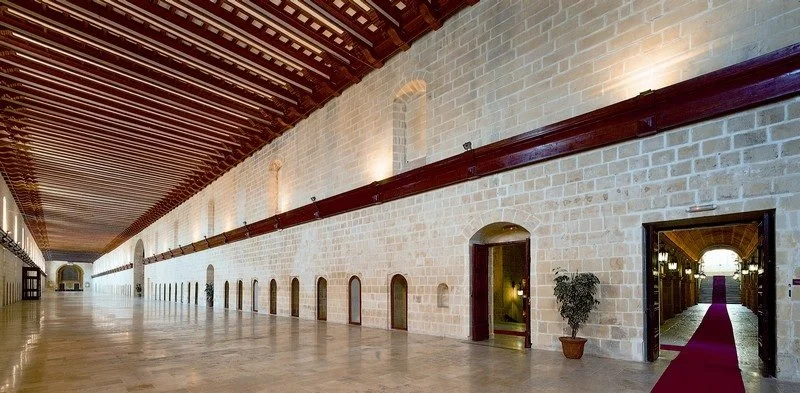
The interior of the Sacra Infermeria, Valletta, once the Hospital of the Order.
After this, all of the senior knights present (the Grand Commander, the Grand Crosses, and the most senior of the other knights) washed the feet of thirteen poor residents of the Hospital, reflecting the ancient Lenten custom of the Order endorsed by de Moulins in 1181. After a table of food was blessed for those whose feet had been washed, the procession returned with the relic to the conventual church, where it was offered for veneration by those present.
This was not the limit of the observance of the Mandatum, however. The washing was carried out with even greater solemnity by the Grand Master. At the eighth hour on Maundy Thursday, the Grand Master would process with all the Grand Crosses, the Prior of the conventual church (the senior cleric of the Order), and the other clergy from the conventual church to the Grand Master’s palace singing the Miserere, Psalm 50.
There, in the great hall of the palace, the same Gospel reading was proclaimed, and then the Grand Master himself, the Prior, and all the Grand Crosses washed the feet of another thirteen poor men, the first of whom was the superior of the Franciscans. Each of the thirteen rested their foot on a silver dish, and was escorted by a knight carrying a silver jug of water for the ablution. The men were then fed at table by the Grand Master and given alms, before the procession returned to the conventual Church, where the offices of Sext and None were sung in choir. At the end of the office of None, the main Mass of the day was celebrated pontifically by the Prior.
The importance placed on the washing of the feet by not just the clergy but also by the lay leaders of the Order reflects the widespread medieval practice of the leaders of all communities, including monarchs, performing the Mandatum in devotional obedience to Our Lord’s example. The only real survival of this practice is the Royal Maundy carried out by His Britannic Majesty - this is a residual survival only, however, as the King no longer washes feet, but rather only distributes alms.
The Mandatum has a particular appropriateness for our Order, reflected in the importance of the practice in the Order from the first century of its existence.
The model of the Order, and the reason that it is important that it remains a noble order, is of those with the highest social status offering their lives in service to “Our Lords the Poor”, upending the social hierarchy and honouring the most humble as the overlords of the highest-born.
This model of life, and likewise the Mandatum, mirrors the words of Our Lord in Matthew 20:26-28, that -
“Whoever would be great among you must be your servant, and whoever would be first among you must be your slave; even as the Son of Man came not to be served but to serve, and to give his life as a ransom for many”.
This description of leadership (and indeed nobility) through self-abasing service is re-emphasised in Our Lord’s commandment in John 13:14-15, that -
“Now that I, your Lord and Teacher, have washed your feet, you also should wash one another’s feet. I have set you an example that you should do as I have done for you.”
It would be fitting for devotion to this practice amongst our members around the world to be revived on Maundy Thursday. For example, if there is a soup kitchen on Maundy Thursday, it could be appropriate for a senior member of the Order present to wash the feet of the guests. Or alternatively, for the Grand Master or Grand Prior of a Grand Priory to carry out a separate service of the washing of the feet at some point in the day prior to the evening Mass of the Lord’s supper. In either case, it would be an evocative sign that the Order is not a mere NGO, but a community devoted to spiritual service in the image of Our Lord.