
Advent with St John the Baptist: “Brood of Vipers”
We are grateful to Père Augustin-Marie Aubry, allowing us to share this reflection on the pivotal role of St John the Baptist, our Holy Patron, in Advent and our preparation for Christmas.
Sermon for IV Sunday of Advent, 21 December 2025
Père Augustin-Marie Aubry, Prior of the Fraternity of St Vincent-Ferrer, Chémeré-le-Roi
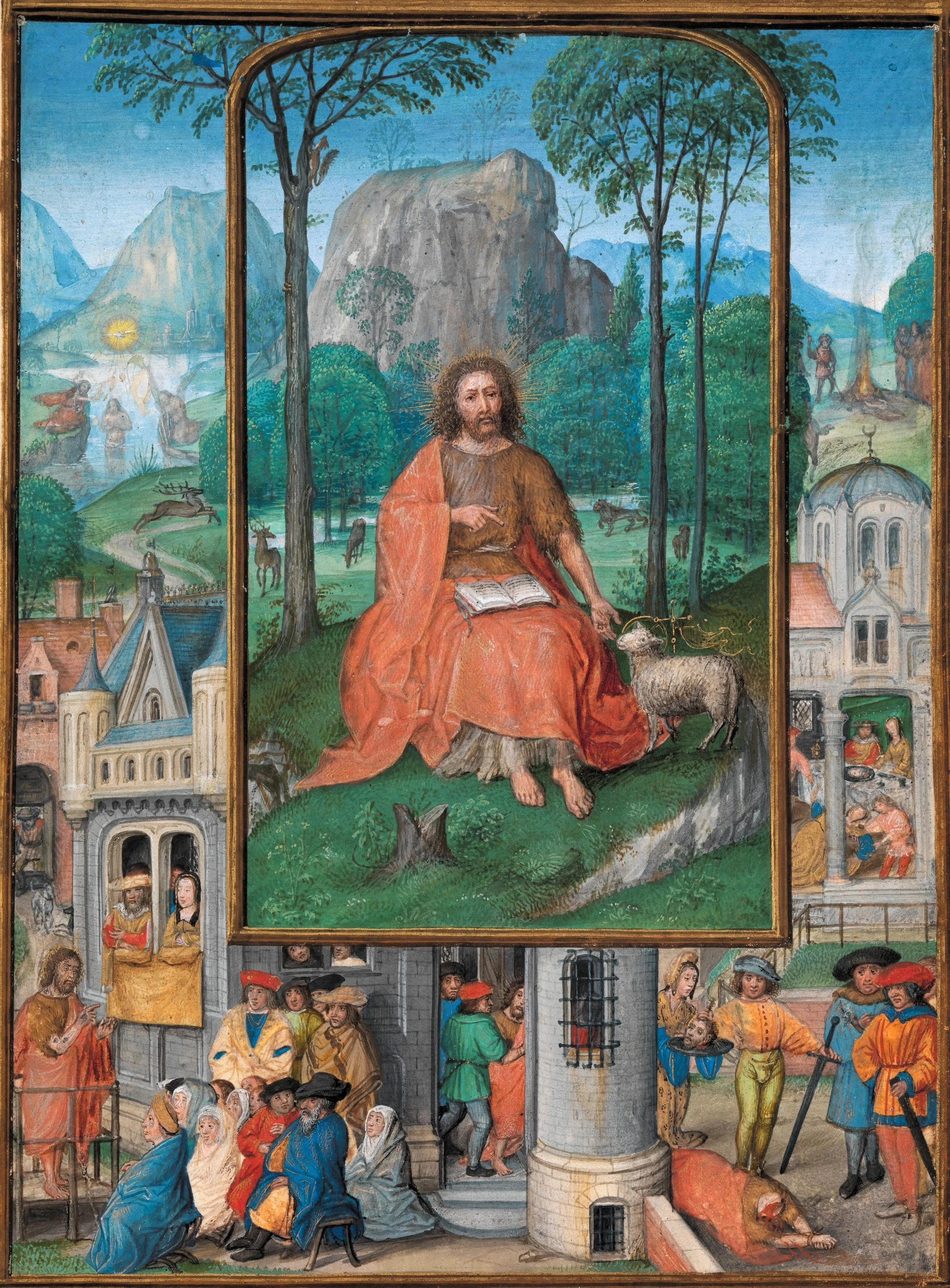
“You brood of vipers!” John the Baptist shouts at the crowd. It is a strange way to win people’s goodwill and attention. But John does not care. He is preaching a baptism of repentance, while waiting for the One who is to come, the One who will baptise with the Holy Spirit and with fire. In the Latin tradition, our preparation for Christmas is shaped mainly by listening to John the Baptist. His powerful—and at the same time deeply appealing—figure appears on the Second, Third, and Fourth Sundays of Advent. Curiously, the liturgy has taken us backward through his life: we began with John in prison, then went back to the baptism in the Jordan, and today we hear his preaching. Because John the Baptist is, above all, a preacher. His words sting—“you brood of vipers!”—because he is the voice of the Word. A voice that wakes people up. A voice that gives commands. A voice that announces news.
I. The Voice that wakes us up
Saint Luke introduces John with great solemnity:
“In the fifteenth year of the reign of Tiberius Caesar, when Pontius Pilate was governor of Judea, Herod tetrarch of Galilee, Philip his brother tetrarch of the region of Iturea and Trachonitis, and Lysanias tetrarch of Abilene, during the high priesthood of Annas and Caiaphas…”
After this impressive list, Luke continues very simply: “The word of God came to John, son of Zechariah, in the desert” (Luke 3:2). Immediately, John begins to preach. He is “the voice crying out in the desert.” Less solemnly, we might say that John is “retweeting” God’s message, because he is the voice of the Word.
John’s cry breaks the silence. It sounds the alarm, like a soldier on watch at the top of the city walls. When we hear his voice, we are shaken out of our sleep and our daydreaming. As Saint Paul said at the beginning of Advent: “It is time now to wake from sleep” (Romans 13:11).
This cry of alarm appears again and again in Scripture, and it is part of the Good News itself: “Here is the bridegroom! Come out to meet him!” (Matthew 25:6). In the parable, all ten virgins are invited to the wedding feast, and all of them wake up when they hear the cry in the night. But the foolish virgins have no oil for their lamps. They are awake, but they have no light. They cannot welcome the bridegroom. What follows is anxiety, disappointment, sadness—the pain of a missed moment.
John’s cry calls us to vigilance. Christmas is only four days away. Let us prepare our oil now, so that we may be ready when the cry is heard in the night.
II. The Voice that commands
John is the voice of the Word. He wakes us up, and he also gives instructions. Taking up the words of the prophet Isaiah, he proclaims: “Prepare the way of the Lord, make his paths straight. Every valley shall be filled, every mountain and hill brought low. The crooked paths shall be made straight, and the rough ways made smooth.” Like the heralds who walked ahead of an emperor’s procession, John goes before the Lord to clear the way and restore order. In ancient times, it was even customary to build a special road for an imperial visit. This practice is not limited to ancient Rome. About thirty years ago, a new road was built in Brittany for the visit of the Polish pope. The road leading to the shrine of Sainte-Anne-d’Auray is still called today “the Pope’s Road.” All this requires serious work. Here, then, is the program for the coming days:
1. Fill in the valleys: share what you have with those in need.
2. Lower the hills: puncture the swelling of pride.
3. Straighten the crooked paths: give up the petty calculations by which we try to control our human affairs.
4. Smooth the rough roads: fight against our character flaws, so that life is easier for those who live and walk beside us.
Saint Ephrem expresses this beautifully in a poem preparing for Christmas:
“On this day when God has come to seek sinners, let the righteous not boast of their good works. On this day when God has become poor, let the rich share their bread with those who have none. On this day when the doors have been opened to our prayer, let us open our own doors to those who have offended us.”
The dynamite that blows apart the rocks blocking the road is absolution in the confessional. If the imperial procession does not find a smooth and straight road, it simply takes another route.
As we prayed this morning at Lauds: “Your all-powerful Word, O Lord, leapt down from your royal throne” (Wisdom 18:15). If the Word does not find a good and generous heart, he passes by and finds rest elsewhere.
III. The Voice that announces
John is the voice of the Word. He wakes us up, he gives orders, and finally he announces: “All flesh shall see the salvation of God.”
John is the voice of the Word, and the Word became flesh so that all flesh might see God’s salvation. This, too, John foretold. The coming of the Word is a coming of salvation. “John saw Jesus coming toward him and said, ‘Behold, the Lamb of God, who takes away the sin of the world. This is he of whom I said: After me comes a man who ranks before me, because he was before me’” (John 1:29–30). John announces the fulfillment of Scripture: a lamb for sacrifice, and at the same time a person who existed before him.
How great John is—he sees, he recognizes, and then he steps aside. When the bridegroom appears, the one who announces him disappears: “I am sent before him. He who has the bride is the bridegroom. The friend of the bridegroom, who stands and hears him, rejoices greatly at the bridegroom’s voice. This joy of mine is now complete. He must increase, and I must decrease” (John 3:28–30). The voice of the Word gives way to the Word himself.
John has prepared us to listen obediently to the voice of Jesus. We are entrusted with an extraordinary treasure, one that no worldly value can rival: God has come to speak to us. Let us be attentive listeners to the Word. After the cries of the newborn in the manger, Jesus will proclaim the Gospel and the Beatitudes.
Conclusion
The voice of John the Baptist wakes us up, gives us direction, and announces salvation. John has done his work. We have been fully warned. In three days, our God will take the trouble to come to us. Let us give ourselves the joy of welcoming him.